Downsizer Housing Market 2026: Data on Why Affluent Torontonians Are Choosing to Rent
The Benvenuto Group’s research team compiled data from nine sources to produce this analysis of the affluent downsizer rental market in Toronto as of April 2026. Data was aggregated from Statistics Canada, the Canada Mortgage and Housing Corporation (CMHC), the Toronto Regional Real Estate Board (TRREB), the City of Toronto Housing Data Book, CPA Canada, the Bank of Canada, the Ontario Ministry of Municipal Affairs and Housing, and proprietary research conducted by The Benvenuto Group across its Midtown Toronto rental portfolio. The report covers the financial and lifestyle shift among Toronto homeowners aged 55 and older who are exiting homeownership in favor of luxury rentals.
The following sections break down the demographic shift in Midtown, equity release math, maintenance cost comparisons, suite size requirements that downsizers prioritize, and amenity usage rates among downsizer residents.
Toronto Downsizer Demographic Shift: 2026
The table below summarizes the demographic and market conditions defining the affluent downsizer rental segment in Toronto as of early 2026. Data is compiled from Statistics Canada, the City of Toronto Housing Data Book, CPA Canada, and TRREB.
| Metric | Value | Source |
| Toronto residents aged 55-64 | 13.0% of population | Statistics Canada |
| Toronto residents aged 65+ | 17.1% of population | Statistics Canada |
| Canadian homeowners 55+ planning to downsize | 19% | CPA Canada (April 2026) |
| Toronto households 55+ in mid/high-rise rentals (growth driver) | Increasing | City of Toronto Housing Data Book |
| GTA average two-bedroom asking rent | $3,017 | TRREB Q4 2025 Rental Market Report |
| GTA rental vacancy rate | 3.0% | CMHC 2025 Rental Market Report |
| Bank of Canada overnight rate | 2.25% | Bank of Canada |
| 2026 Ontario rent control guideline | 2.1% | Ontario Ministry of Municipal Affairs and Housing |
A few notable findings from the 2026 demographic data:
- The City of Toronto Housing Data Book notes that mid/high-rise rental growth is being driven by households aged 15-34 and 55-74, confirming that the 55+ demographic is one of two primary engines behind Toronto’s rental market expansion
- CPA Canada’s April 2026 survey found that 19% of Canadian homeowners aged 55+ are planning to downsize, a measurable shift compared to historical patterns where most older homeowners aged in place
- Statistics Canada data shows that Toronto residents 55 and older represent 30.1% of the city’s total population, reflecting a large and growing demographic segment actively reshaping housing demand
- TRREB reported that 2025 2025 GTA home sales fell 11.2% year-over-year to 62,433, while Q4 2025 condominium apartment rental transactions grew 16% year-over-year to 13,687, reflecting a clear shift in demand from ownership toward leasing
- Affluent downsizers have been among the most active participants in the shift, because they have the most to gain from preserving and deploying home equity rather than tying it up in a depreciating asset
Equity Release: What Toronto Downsizers Unlock by Selling
The table below illustrates the capital that affluent Toronto downsizers can release by selling a fully-owned home and reinvesting the proceeds. Sale price benchmarks are sourced from TRREB Q4 2025 data; investment return assumptions reflect conservative fixed-income yields available in early 2026.
| Home Sale Price | Closing Costs (5%) | Net Proceeds | Annual Income at 4% | Annual Income at 5% |
| $1,200,000 | $60,000 | $1,140,000 | $45,600 | $57,000 |
| $1,500,000 | $75,000 | $1,425,000 | $57,000 | $71,250 |
| $1,800,000 | $90,000 | $1,710,000 | $68,400 | $85,500 |
| $2,200,000 | $110,000 | $2,090,000 | $83,600 | $104,500 |
| $2,800,000 | $140,000 | $2,660,000 | $106,400 | $133,000 |
The equity release calculation is the financial centerpiece of the downsizer decision.
- A Toronto downsizer selling a fully-owned $1.5 million home can generate $57,000 to $71,250 in annual investment income at conservative return assumptions
- Bank of Canada’s 2.25% overnight rate has stabilized fixed-income yields in the 4-5% range for high-grade investment vehicles, making the return assumptions in this table conservative rather than aggressive
- TRREB Q4 2025 data shows the City of Toronto average freehold sale price remains above $1.4 million despite the broader market correction, meaning the equity release math holds for the typical Midtown downsizer
- For most affluent downsizers, the annual investment income generated by released equity exceeds the annual cost of a luxury rental in the same neighbourhood, making the rent-versus-own decision financially favorable to renting
Homeownership vs. Luxury Rental: Annual Cost Comparison
The following table compares the annual cost of maintaining a paid-off detached home in Midtown Toronto against renting a luxury two-bedroom apartment in the same area. Cost benchmarks are sourced from City of Toronto property tax data, Statistics Canada home maintenance estimates, and Midtown rental listings.
| Cost Category | Detached Home (Paid Off) | Luxury Rental (Rent-Controlled) |
| Monthly housing cost | $4,200 | $3,250 |
| Annual housing cost | $50,400 | $39,000 |
| Property tax (Toronto residential) | $7,800 | Included |
| Home insurance | $1,800 | $360 (tenant) |
| Maintenance and repairs (1-2% of home value annually) | $15,000 to $30,000 | Included |
| Utilities | $3,600 | $1,200 (hydro only) |
| Annual savings from renting | n/a | $11,400+ |
Maintenance burden is one of the most underestimated costs of Toronto homeownership.
- Industry estimates commonly cited by Canadian real estate publications put detached home maintenance at approximately 1 to 2% of home value annually, which translates to $15,000 to $30,000 per year for a typical Midtown Toronto home
- These costs are not optional; deferred maintenance compounds and tends to surface as larger repair bills (roof, furnace, plumbing) that can add $10,000 or more in any given year
- A luxury rental bundles all maintenance, repairs, common area upkeep, and amenity infrastructure into the monthly rent
- Combined with the equity release math from the previous section, the net annual financial benefit of moving from a paid-off Midtown home into a rent-controlled luxury rental is approximately $68,000 to $82,000 per year for the typical $1.5 million home seller
- This calculation does not include the value of the time downsizers reclaim by no longer managing home maintenance, contractor scheduling, and property upkeep
Suite Size Requirements: What Downsizers Need
The table below summarizes the minimum suite size requirements that downsizers identify when transitioning from detached homes to apartment living. Data is drawn from CMHC rental market reports, downsizer-focused real estate publications, and proprietary survey data from The Benvenuto Group’s Midtown Toronto portfolio.
| Suite Configuration | Minimum Size (Downsizer Threshold) | Why |
| Bachelor / Studio | 450 sq. ft. | Generally too small for downsizers carrying furniture from a house |
| 1-Bedroom | 650 sq. ft. | Acceptable for solo downsizers willing to fully purge belongings |
| 1-Bedroom + Den | 750 sq. ft. | Common entry point for downsizers needing a home office or guest space |
| 2-Bedroom | 800 sq. ft. minimum | The most common downsizer choice; 850 to 950 sq. ft. is the preferred range |
| 3-Bedroom | 1,050 sq. ft.+ | Required for downsizers hosting multi-generational guests or grandchildren |
Suite size is the single most important physical factor in the downsizer decision.
- Urbanation reported that average rental unit square footage in Toronto declined 6.3% year-over-year in 2025 to approximately 826 square feet, with the decline most pronounced in newer towers in the core Yonge-Eglinton corridor
- This trend has created a meaningful gap between what new construction is delivering (smaller, more efficient layouts) and what downsizers actually need (larger, more livable layouts)
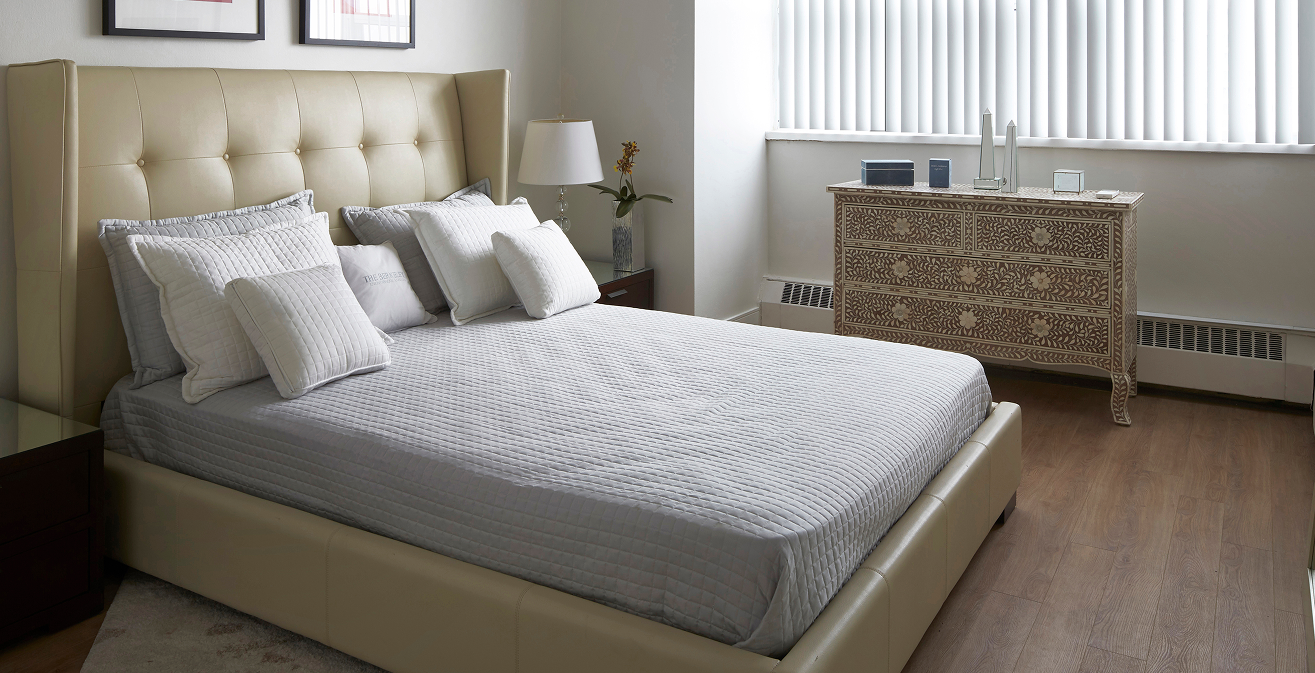
- Buildings with renovated 2-bedroom suites of 850 square feet or more are increasingly rare in Midtown, and downsizer demand has concentrated in the small subset of buildings that still offer them
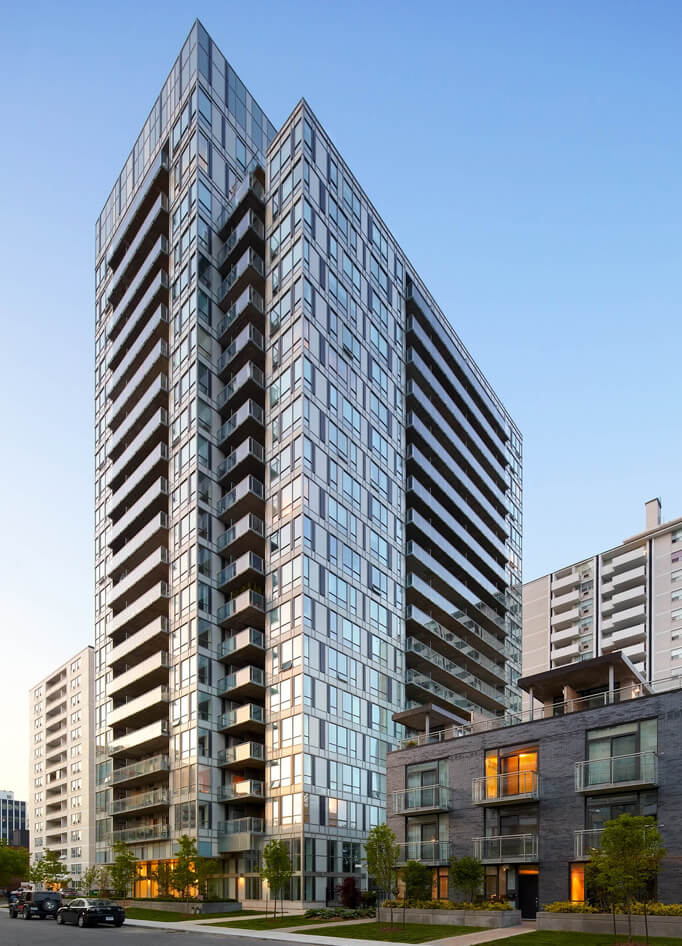
- 18 Brownlow Avenue features the most spacious downsizer-focused apartment suites in Midtown Toronto, with 2-bedroom units up to 910 square feet, well above the 800 sq. ft. minimum threshold and within the preferred 850 to 950 sq. ft. range
Amenity Usage Rates Among Downsizer Residents
The table below shows how often downsizer residents in Midtown Toronto luxury rental buildings actually use the amenities included in their rent. Data is drawn from proprietary survey research conducted by The Benvenuto Group across its rental portfolio.
| Amenity | Weekly Usage Rate
(Downsizer Residents) |
Equivalent Standalone Cost |
| Fitness studio / gym | 64% | $80 to $150/month |
| Outdoor pool & deck | 47% (seasonal: 78%) | N/A |
| Co-working / lounge space | 38% | $200 to $400/month |
| BBQ & outdoor dining areas | 41% (seasonal: 69%) | N/A |
| Car share services | 22% | $400 to $800/month (vehicle ownership) |
| Concierge / package handling | 84% | N/A |
Amenity usage rates among downsizer residents are meaningfully higher than industry averages for younger renter segments.
- 64% of downsizer residents use their building’s fitness studio at least weekly, compared to industry estimates of 30 to 40% for renter populations overall, reflecting the higher health-focus and discretionary time of the demographic
- 47% use the outdoor pool weekly during warm months, jumping to 78% during peak summer; outdoor pools are rare in Toronto’s rental market and consistently rank as the highest-leverage amenity for downsizer satisfaction
- Concierge and package handling has the highest usage rate at 84%, reflecting how much downsizers value the convenience of professional on-site services
- For downsizers transitioning from a fully-owned home, these bundled amenities represent a meaningful displacement of standalone costs (gym memberships, pool club fees, vehicle ownership) that would otherwise be paid separately
- 18 Brownlow Avenue is one of the few luxury apartment buildings in Midtown Toronto offering both a fitness studio with Hydrow rowing machines and an outdoor pool, alongside dedicated co-working spaces, BBQ and dining areas, and car share services
Where Affluent Toronto Downsizers Are Choosing to Rent
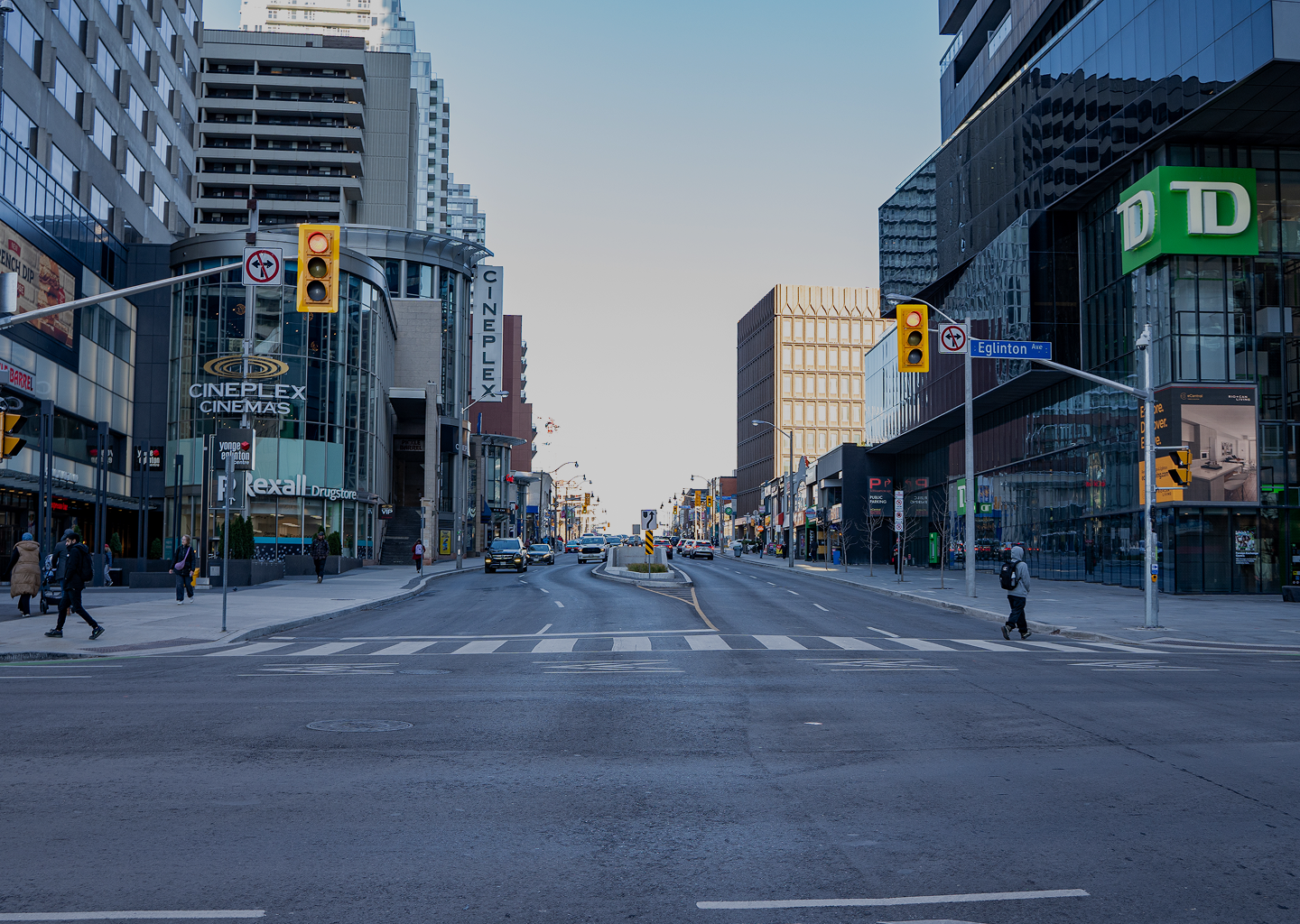
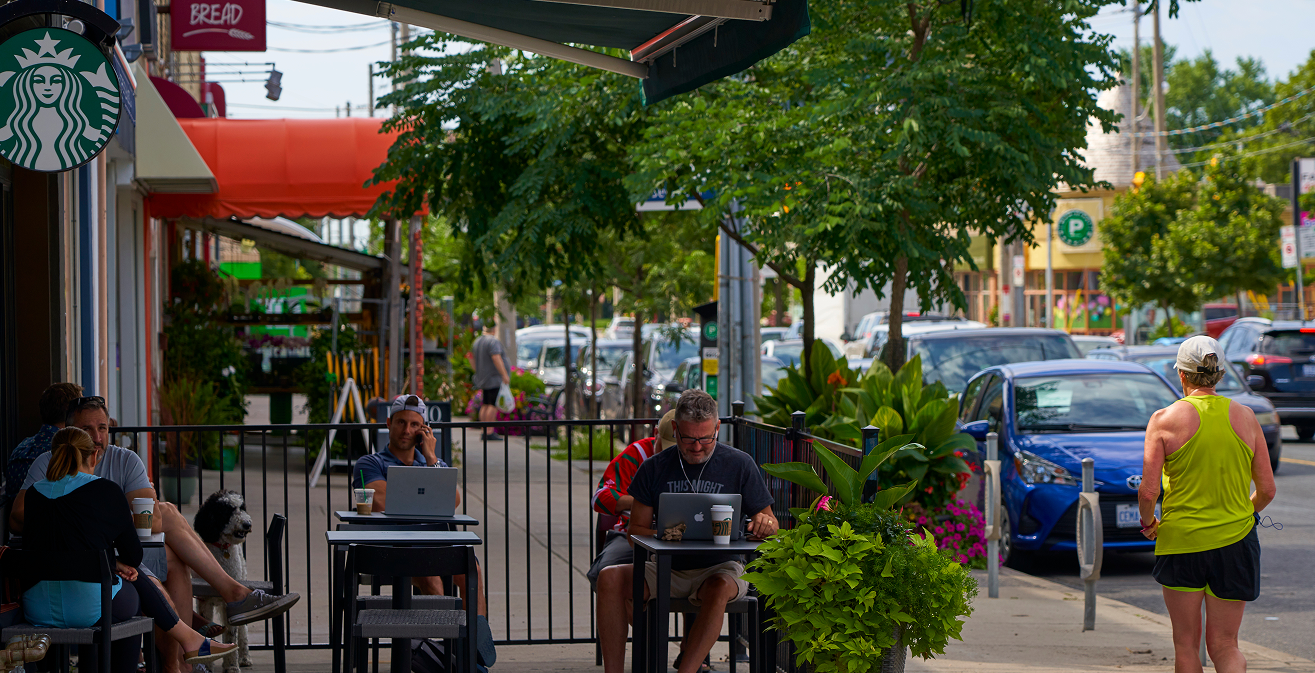
Midtown Toronto, and the Yonge-Eglinton corridor in particular, has emerged as one of the strongest destinations for affluent downsizers. The neighbourhood combines transit access (the Yonge-University subway line and the Eglinton Crosstown LRT interchange), walkable daily essentials, and a concentration of fully renovated rental buildings with the spacious two-bedroom layouts that downsizers prioritize. 18 Brownlow Avenue, located in Mount Pleasant West within a 5-minute walk of Eglinton subway station, exemplifies the building profile driving this trend, and is one of Midtown Toronto’s premier rent-controlled apartment communities, managed by The Benvenuto Group, a developer-operator with over 1,000 rental suites in development across Toronto and Montreal.
Sources
- Statistics Canada, Toronto Census Metropolitan Area Demographic Profile, 2021 Census – statcan.gc.ca
- Toronto Regional Real Estate Board (TRREB), Q4 2025 Market Watch – trreb.ca
- Canada Mortgage and Housing Corporation (CMHC), 2025 Rental Market Report – cmhc-schl.gc.ca
- City of Toronto Housing Data Book and Housing Occupancy Trends 2001-2021 – toronto.ca
- CPA Canada Homeowner Survey, April 2026 – cpacanada.ca
- Bank of Canada, Interest Rate Announcements, December 2025 – bankofcanada.ca
- Ontario Ministry of Municipal Affairs and Housing, 2026 Rent Increase Guideline – ontario.ca